> ## Documentation Index
> Fetch the complete documentation index at: https://firespark.cloud/docs/llms.txt
> Use this file to discover all available pages before exploring further.
# Architecture
> How your POS or RMS connects to Fire spark and every sales channel.
## Fire spark modules
 ## Platform overview
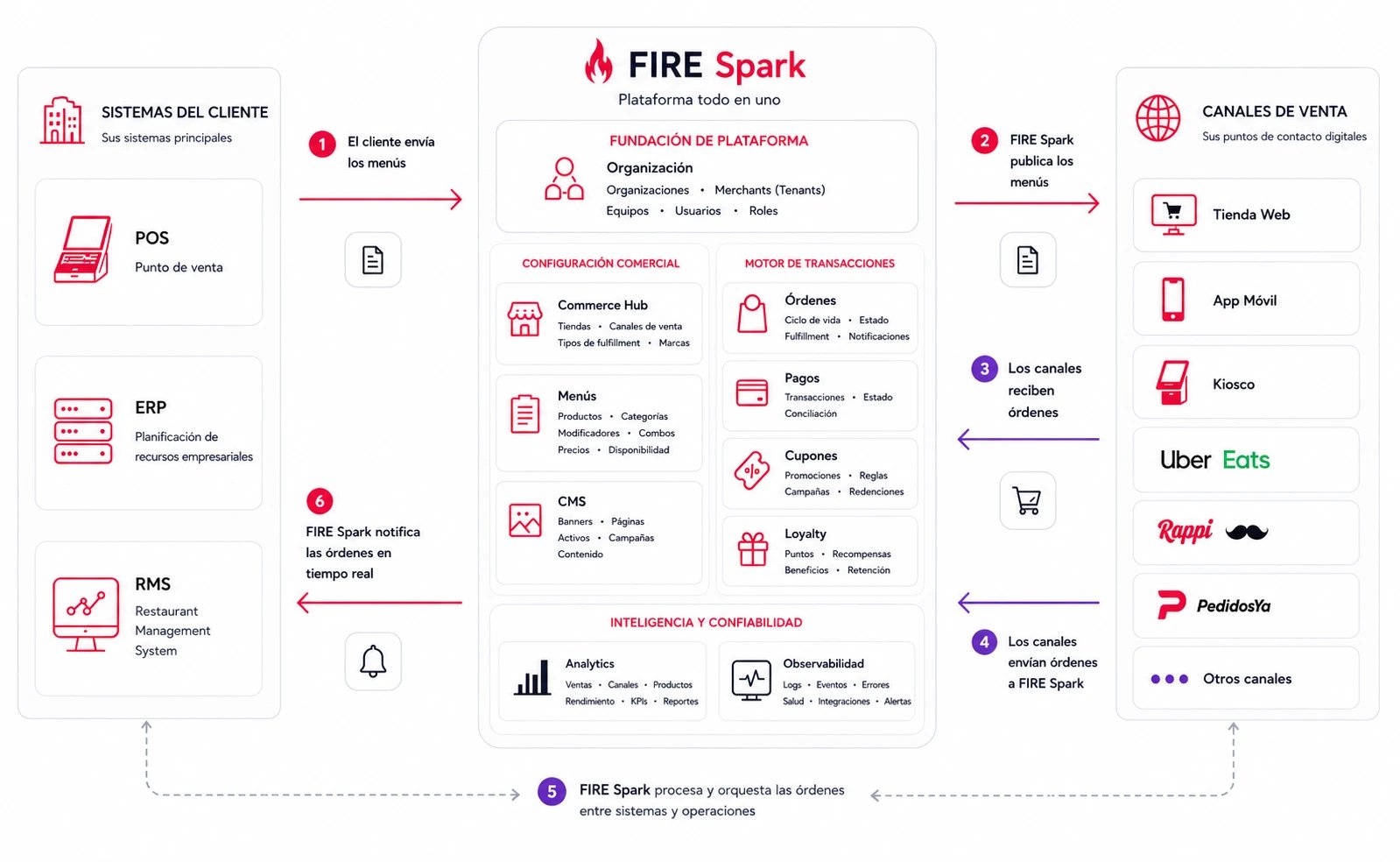
Fire spark sits between your operational stack and every surface where customers order. Your POS or RMS stays the source of truth; Fire spark syncs menus outward and routes orders back.
```mermaid theme={null}
flowchart TB
subgraph POS["Operational layer — source of truth"]
POS1["Toast · Aloha · Symphony · Pixel Point"]
POS2["Fire POS (native RMS)"]
end
subgraph FS["Fire spark"]
DASH["Dashboard"]
INT["Integrations API\n/api/integrations/v1"]
INTEL["Omnichannel layer\nmenu composition · routing"]
ORD["Order engine\nwebhooks · order.injected"]
end
subgraph OWNED["Owned channels"]
SF["Storefront API"]
APP["App · Web · Kiosk · Call center"]
end
subgraph AGG["Aggregators"]
UE["Uber Eats · Rappi · PedidosYa"]
end
POS1 -->|"Menus, pricing, availability"| INT
POS2 <-->|"Native integration"| FS
INT --> INTEL
INTEL --> UE
INTEL --> SF
SF --> APP
UE & APP -->|"Customer order"| ORD
ORD -->|"order.injected webhook"| INT
INT -->|"Kitchen ticket"| POS1
ORD --> POS2
DASH -.-> INT
```
## Menu sync (POS → channels)
Catalog data flows from your POS or RMS into Fire spark, which composes and publishes menus to each channel.
```mermaid theme={null}
flowchart LR
subgraph POS["POS / RMS"]
CAT["Catalog master"]
end
subgraph FS["Fire spark"]
INT["Integrations API"]
COMPOSE["Menu composition\nchannel · store · fulfillment · schedule"]
end
subgraph CH["Sales channels"]
APP["App"]
WEB["Web"]
UE["Uber Eats"]
OTHER["Rappi · PedidosYa · kiosk · …"]
end
CAT -->|"PUT /menus\nPUT /menus/products/{id}"| INT
INT --> COMPOSE
COMPOSE --> APP & WEB & UE & OTHER
```
## Order flow (channels → POS)
When a customer checks out on any channel, Fire spark notifies your integration and hands off the order to your POS or RMS.
```mermaid theme={null}
sequenceDiagram
autonumber
participant POS as POS / RMS
participant FS as Fire spark
participant CH as Sales channel
participant INT as Your integration server
CH->>FS: Customer checkout
FS->>INT: order.created
FS->>INT: order.injected
INT->>POS: Create kitchen ticket
POS->>INT: Fulfillment progress
INT->>FS: PATCH /orders/{id}/status
FS->>CH: Status update
```
## Menu composition by context
Each composed menu is scoped to a store, channel, and fulfillment type. Schedules can further restrict when it is active.
```mermaid theme={null}
flowchart TB
MASTER["POS catalog"]
MASTER --> M1["downtown · app · delivery"]
MASTER --> M2["downtown · uber-eats · delivery"]
MASTER --> M3["downtown · app · pickup"]
MASTER --> M4["airport · app · delivery"]
M1 --> S1["Weekday lunch\n11:00–15:00"]
M2 --> S2["Aggregator subset · all day"]
```
## Defaults and targeted overrides
Omit scope in the URL or payload to apply a menu broadly, then override only where your operation differs.
```mermaid theme={null}
flowchart TB
BASE["PUT /menus\n(no fulfillment_id · no store_id · no channel_id · no brand_id · schedules: null)\n→ merchant-wide default · 24/7"]
BASE --> O1["?channel_id=uber-eats"]
BASE --> O2["?store_id=airport"]
BASE --> O3["schedules on menu entry"]
```
| Omitted | Assumed |
| ---------------------------------- | -------------------------------- |
| `store_id` query parameter | Any store (`__ANY__`) |
| `channel_id` query parameter | Any channel (`__ANY__`) |
| `fulfillment_id` on the menu entry | Any fulfillment type (`__ANY__`) |
| `schedules: null` | 24 hours, every day |
## Modifier model
Modifiers are products. Groups define the choice rules on a parent item.
```mermaid theme={null}
flowchart TB
COMBO["Combo meal (product)"]
COMBO --> G1["Group: Choose a drink\nmin 1 · max 1"]
G1 --> M1["Cola (product)"]
G1 --> M2["Sprite (product)"]
G1 --> M3["Still water (product)"]
COMBO --> G2["Group: Add extras\nmin 0 · max 3"]
G2 --> M4["Extra cheese (product)"]
G2 --> M5["Bacon (product)"]
```
## Infrastructure
## Platform overview
Fire spark sits between your operational stack and every surface where customers order. Your POS or RMS stays the source of truth; Fire spark syncs menus outward and routes orders back.
```mermaid theme={null}
flowchart TB
subgraph POS["Operational layer — source of truth"]
POS1["Toast · Aloha · Symphony · Pixel Point"]
POS2["Fire POS (native RMS)"]
end
subgraph FS["Fire spark"]
DASH["Dashboard"]
INT["Integrations API\n/api/integrations/v1"]
INTEL["Omnichannel layer\nmenu composition · routing"]
ORD["Order engine\nwebhooks · order.injected"]
end
subgraph OWNED["Owned channels"]
SF["Storefront API"]
APP["App · Web · Kiosk · Call center"]
end
subgraph AGG["Aggregators"]
UE["Uber Eats · Rappi · PedidosYa"]
end
POS1 -->|"Menus, pricing, availability"| INT
POS2 <-->|"Native integration"| FS
INT --> INTEL
INTEL --> UE
INTEL --> SF
SF --> APP
UE & APP -->|"Customer order"| ORD
ORD -->|"order.injected webhook"| INT
INT -->|"Kitchen ticket"| POS1
ORD --> POS2
DASH -.-> INT
```
## Menu sync (POS → channels)
Catalog data flows from your POS or RMS into Fire spark, which composes and publishes menus to each channel.
```mermaid theme={null}
flowchart LR
subgraph POS["POS / RMS"]
CAT["Catalog master"]
end
subgraph FS["Fire spark"]
INT["Integrations API"]
COMPOSE["Menu composition\nchannel · store · fulfillment · schedule"]
end
subgraph CH["Sales channels"]
APP["App"]
WEB["Web"]
UE["Uber Eats"]
OTHER["Rappi · PedidosYa · kiosk · …"]
end
CAT -->|"PUT /menus\nPUT /menus/products/{id}"| INT
INT --> COMPOSE
COMPOSE --> APP & WEB & UE & OTHER
```
## Order flow (channels → POS)
When a customer checks out on any channel, Fire spark notifies your integration and hands off the order to your POS or RMS.
```mermaid theme={null}
sequenceDiagram
autonumber
participant POS as POS / RMS
participant FS as Fire spark
participant CH as Sales channel
participant INT as Your integration server
CH->>FS: Customer checkout
FS->>INT: order.created
FS->>INT: order.injected
INT->>POS: Create kitchen ticket
POS->>INT: Fulfillment progress
INT->>FS: PATCH /orders/{id}/status
FS->>CH: Status update
```
## Menu composition by context
Each composed menu is scoped to a store, channel, and fulfillment type. Schedules can further restrict when it is active.
```mermaid theme={null}
flowchart TB
MASTER["POS catalog"]
MASTER --> M1["downtown · app · delivery"]
MASTER --> M2["downtown · uber-eats · delivery"]
MASTER --> M3["downtown · app · pickup"]
MASTER --> M4["airport · app · delivery"]
M1 --> S1["Weekday lunch\n11:00–15:00"]
M2 --> S2["Aggregator subset · all day"]
```
## Defaults and targeted overrides
Omit scope in the URL or payload to apply a menu broadly, then override only where your operation differs.
```mermaid theme={null}
flowchart TB
BASE["PUT /menus\n(no fulfillment_id · no store_id · no channel_id · no brand_id · schedules: null)\n→ merchant-wide default · 24/7"]
BASE --> O1["?channel_id=uber-eats"]
BASE --> O2["?store_id=airport"]
BASE --> O3["schedules on menu entry"]
```
| Omitted | Assumed |
| ---------------------------------- | -------------------------------- |
| `store_id` query parameter | Any store (`__ANY__`) |
| `channel_id` query parameter | Any channel (`__ANY__`) |
| `fulfillment_id` on the menu entry | Any fulfillment type (`__ANY__`) |
| `schedules: null` | 24 hours, every day |
## Modifier model
Modifiers are products. Groups define the choice rules on a parent item.
```mermaid theme={null}
flowchart TB
COMBO["Combo meal (product)"]
COMBO --> G1["Group: Choose a drink\nmin 1 · max 1"]
G1 --> M1["Cola (product)"]
G1 --> M2["Sprite (product)"]
G1 --> M3["Still water (product)"]
COMBO --> G2["Group: Add extras\nmin 0 · max 3"]
G2 --> M4["Extra cheese (product)"]
G2 --> M5["Bacon (product)"]
```
## Infrastructure